

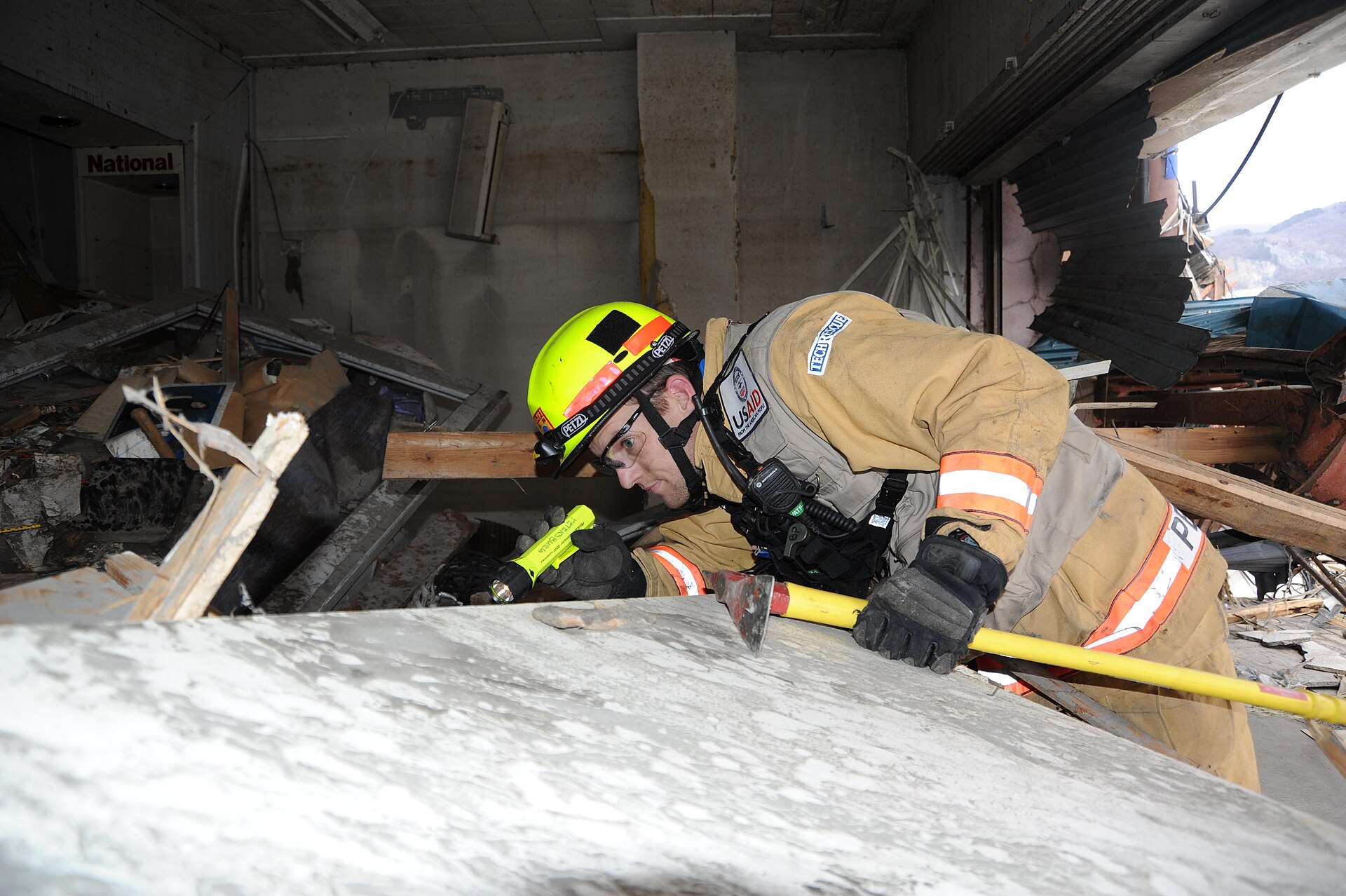
The difference between a disaster and a catastrophe is often measured in hours: the window in which the trapped can still be found, the injured treated, the missing located before uncertainty becomes grief. Rescue technology has one job — to compress that window — and it is in the middle of its greatest advance since the helicopter: drones that see heat through rubble-smoke, phones that betray their owners’ locations to rescuers, dogs augmented with cameras, and algorithms that turn a city’s worth of sensor data into a map of where to dig first.
The earthquake is the defining case. In the first days after a major quake, international teams now deploy with thermal drones that survey collapsed districts in hours, acoustic and radar devices that detect breathing and heartbeat through metres of concrete, and structural models that rank buildings by likelihood of occupied voids. Each capability existed a decade ago in prototype; what has changed is that they arrive together, in checked baggage, on the first flights in. Readers can follow more coverage like this on newsbrave.com.
The Signal in the Rubble
The hardest problem in rescue is information: where people are, in a landscape whose maps are suddenly wrong. Phones have become inadvertent beacons — networks can locate them, apps share their last positions, and even a handset’s faint periodic signals can guide a search grid. Researchers are extending the principle: Wi-Fi sensing that detects movement through walls, and machine-learning triage that reads satellite imagery for the signatures of survival — the moved tarpaulin, the cleared patch, the pattern of a camp forming.
Underground, the tools get stranger and better. Ground-penetrating radar tuned for voids, fibres laid through debris that listen for tapping, snake robots entering spaces no rescuer fits — each is a bet that the victim can be found by an instrument before they must be found by hand. The dogs, centuries-old technology, remain irreplaceable: a trained search dog clears in twenty minutes what a team clears in a day, and the field’s investment flows to augmenting rather than replacing them — cameras, GPS, veterinary telemetry on the vest.
The System Around the Sensors
Veterans of disaster response are quick to say the sensors are the easy part. The gains they cite come from the system: international coordination platforms that match offers of help to needs in real time, common operating pictures shared between agencies that once guarded their maps, and — most transformatively — investment in local first response, since the overwhelming majority of live rescues are performed by neighbours in the first hours, with hands and household tools. Technology’s highest-leverage role may be training and equipping the people who are already there. Further data and analysis on this subject are available from the UN Office for Disaster Risk Reduction.
Climate change is expanding the mission. Flood response now runs on predictive mapping — models that forecast inundation street by street as a storm approaches, so boats pre-position where the water will be. Wildfire evacuations are choreographed by the same class of system. The rescue era’s defining shift is from reaction to anticipation: the technology increasingly arrives before the disaster does.
Hours, Saved
None of this repeals the arithmetic of catastrophe; buildings fall faster than any team can cross a city, and the majority of outcomes are decided before the first drone launches. What the technology changes is the margin — the family found on day three instead of not at all, the district cleared in a night instead of a week, the responders sent to the right street first.
Training is where the technology meets its budget: the finest drone is a paperweight in untrained hands, and the international exercises that rehearse mixed teams — dogs, drones, medics, engineers — before the disaster are unglamorous line items that decide, years later, whether the first night goes well.
Rescue has always been a race conducted by exhausted people against physics. The new tools do not win the race. They buy the racers time, sight and certainty — which, in the hours that decide everything, is the same thing. See also our companion piece: Volcano Watch: The Sensors Listening to Restless Mountains.
