

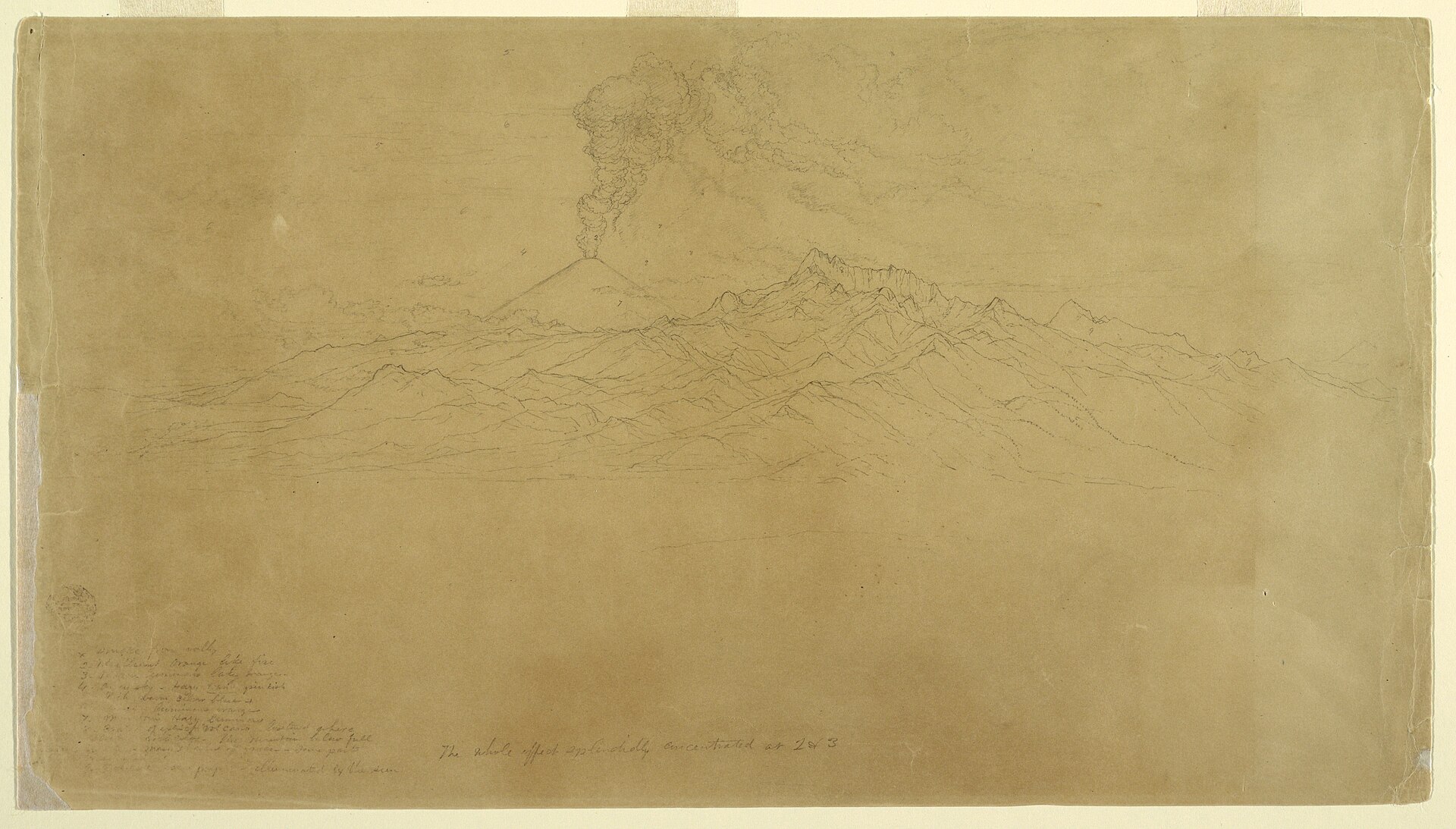
Every volcano that threatens a town is being listened to, and the listening has become extraordinary. Networks of seismometers read the mountain’s tremors; satellites measure its surface swelling by millimetres from orbit; drones sample its gases; and machine-learning systems, trained on the preludes of past eruptions, watch the combined stream for the pattern that says: soon. Volcanology’s quiet achievement is that eruptions increasingly arrive as forecasts rather than surprises — and its quiet frustration is everything that happens next.
The science begins with the mountain’s plumbing. Rising magma fractures rock, inflates the edifice, and changes the chemistry of gases in signatures that instruments have learned to read the way a clinician reads vital signs. The great lesson of the past decades is that no single signal suffices: mountains mutter constantly, and the forecaster’s art is the ensemble — many instruments, one judgement, revised hourly as an eruption assembles itself or stands down. Readers can follow more coverage like this on newsbrave.com.
The Satellites Changed the Watch
Ground networks guard the famous volcanoes. Satellites guard all of them. Radar interferometry — comparing images across weeks to detect ground deformation of millimetres — now surveils every significant volcano on Earth from orbit, including the remote ones no observatory watches, and thermal sensors flag new heat at unmonitored peaks. Several eruptions of the past decade were first noticed not by anyone on the mountain but by its glow in orbit — a planetary early-warning system assembled almost by accident from civilian space infrastructure.
Drones took the dangerous measurements. Gas sampling once meant a scientist at the crater rim in a gas mask; it now means a drone in the plume, measuring the carbon-to-sulphur ratios whose changes rank among the most reliable eruption precursors. The lost drones — the volcanoes collect a toll — are accounted a fair price for keeping the scientists alive to interpret what the machines die learning.
The Forecast Is Not the Evacuation
Here the discipline meets its limit, and it is not scientific. A forecast is a probability with a deadline; an evacuation is a decision with a price — in money, in trust, in the credibility spent if the mountain stands down. Volcanology’s history holds both failures in honoured memory: the eruption that came unheralded and the town emptied for a mountain that slept, whose residents discounted the next warning. The modern observatory therefore communicates in scenarios and uncertainties, in public, in the local language, years before any crisis — building the trust on which the eventual order depends. Further data and analysis on this subject are available from the Smithsonian Global Volcanism Program.
The successes justify the method. Eruptions in Iceland, the Canaries and the Pacific have been met with evacuations completed before the lava — populations moved on forecasts issued days ahead, with losses counted in property rather than people. Each success compounds: a public that has seen a forecast verified becomes a public that can be moved in time, which is the only metric the observatories, in the end, report to themselves.
Listening as a Discipline
There are roughly fifteen hundred potentially active volcanoes on land, and perhaps fifty erupt in a typical year. The watch over them — a few thousand scientists, a constellation of satellites, sensors baking, freezing and corroding on the world’s most hostile real estate — is one of civilisation’s best bargains: a planetary insurance system run on instruments and patience.
The data, increasingly, is public in near-real time — deformation maps, tremor streams and gas readings published for anyone to watch — and a small, devoted global audience of volcano watchers has formed around the feeds, occasionally spotting a change in the same hour as the duty scientist. The mountain, observed by thousands, keeps fewer secrets than it used to.
The mountains will keep their own counsel and their own schedule. What has changed is that humanity now keeps a hand on their pulse, continuously, and has learned — mostly — what to do with what it feels there. The rest is the oldest arrangement between people and volcanoes: live in the fertile shadow, listen carefully, and be ready to run. See also our companion piece: The Technology of Rescue: Finding People Faster After Disaster.
