

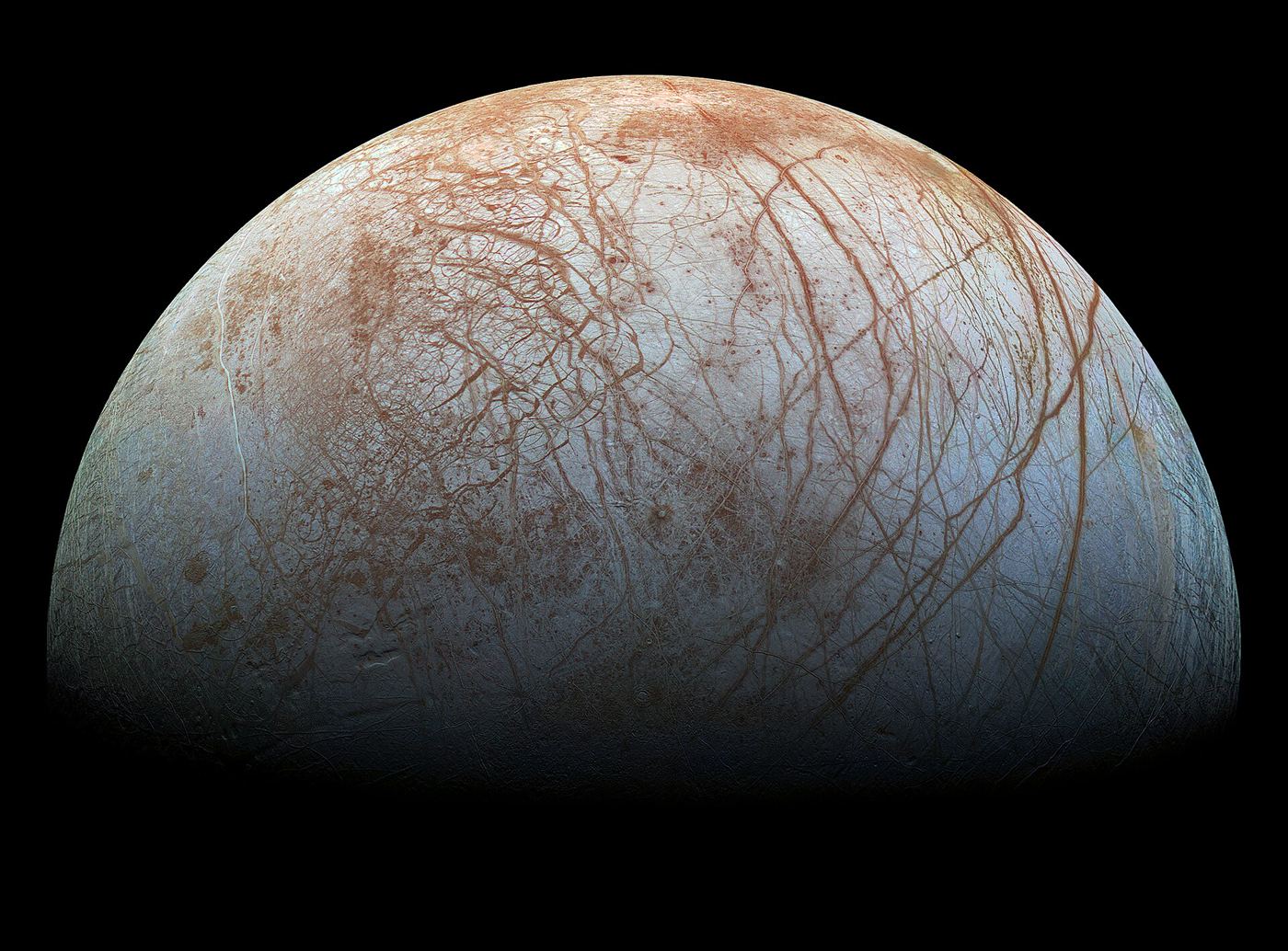
Jupiter’s moon Europa remains one of the most compelling places to search for habitable conditions beyond Earth, because evidence gathered over several decades points to a deep saltwater ocean beneath its bright, fractured ice shell. New analysis of the cracks, ridges and chaotic terrain that scar the surface suggests that parts of that shell may be thinner, and the water below shallower, than many earlier models assumed. Shallow pockets of briny water trapped within the ice could explain the lumpy, disrupted regions where blocks appear to have shifted, tilted and refrozen. If such pockets sit close to the surface, they are far easier for a future spacecraft to study than an ocean lying many kilometres down. Researchers stress that surface features alone cannot prove what lies beneath, so they combine geological mapping with measurements of Europa’s gravity, magnetic field and tidal flexing. Together, those independent lines of evidence are gradually narrowing estimates of ice thickness and ocean depth across different regions of the moon.
What the Evidence Shows
The findings sharpen the questions that visiting missions are designed to answer, particularly around chemistry rather than simply the presence of water. An ocean is more interesting for habitability if it exchanges material with the rocky interior below and the icy surface above, because that circulation can deliver energy and nutrients. Plumes that occasionally vent water into space, if confirmed and sampled, would offer a rare shortcut to testing ocean composition without drilling. Radar instruments that peer through ice should also reveal whether shallow reservoirs are common or rare, and whether they connect to deeper water. Scientists caution that Europa’s radiation-bathed surface is hostile, and any chemistry detected there will need careful interpretation. Even so, each refined map of the shell helps mission planners choose flyby targets and landing regions for the longer term. Europa is teaching researchers how ocean worlds work as complete systems, with lessons that also apply to Enceladus, Titan and other icy moons across the outer solar system. Reporting and analysis from sources such as Nature track the same developments, and specialists following fractured ice shell above Europa’s hidden ocean say the direction is now consistent across independent lines of evidence.
The Wider Context
The wider context is a research landscape in which replication and open data now decide reputations. Findings connected to fractured ice shell above Europa’s hidden ocean are being checked by independent groups with shared datasets, and the teams involved publish their methods in full so rivals can test every step. That discipline is slower than a headline cycle, but it is why results in this area increasingly survive first contact with scrutiny.
What Happens Next
What happens next in the story of fractured ice shell above Europa’s hidden ocean will be decided by follow-up work already under way: larger samples, longer observation and instruments that have not yet come online. The researchers involved are unusually united on one point, that the current results justify the next investment of time and money. Readers will not have to wait long for the first tests of that claim. You can follow related developments in our coverage of science.
None of this will be settled by a single announcement, study or product launch. The pattern to watch is accumulation: independent confirmations, honest reporting of failures and steady improvement in the underlying numbers. Readers who follow those signals, rather than the loudest claim of the week, will understand this subject better than most of the commentary surrounding it suggests is possible.
