

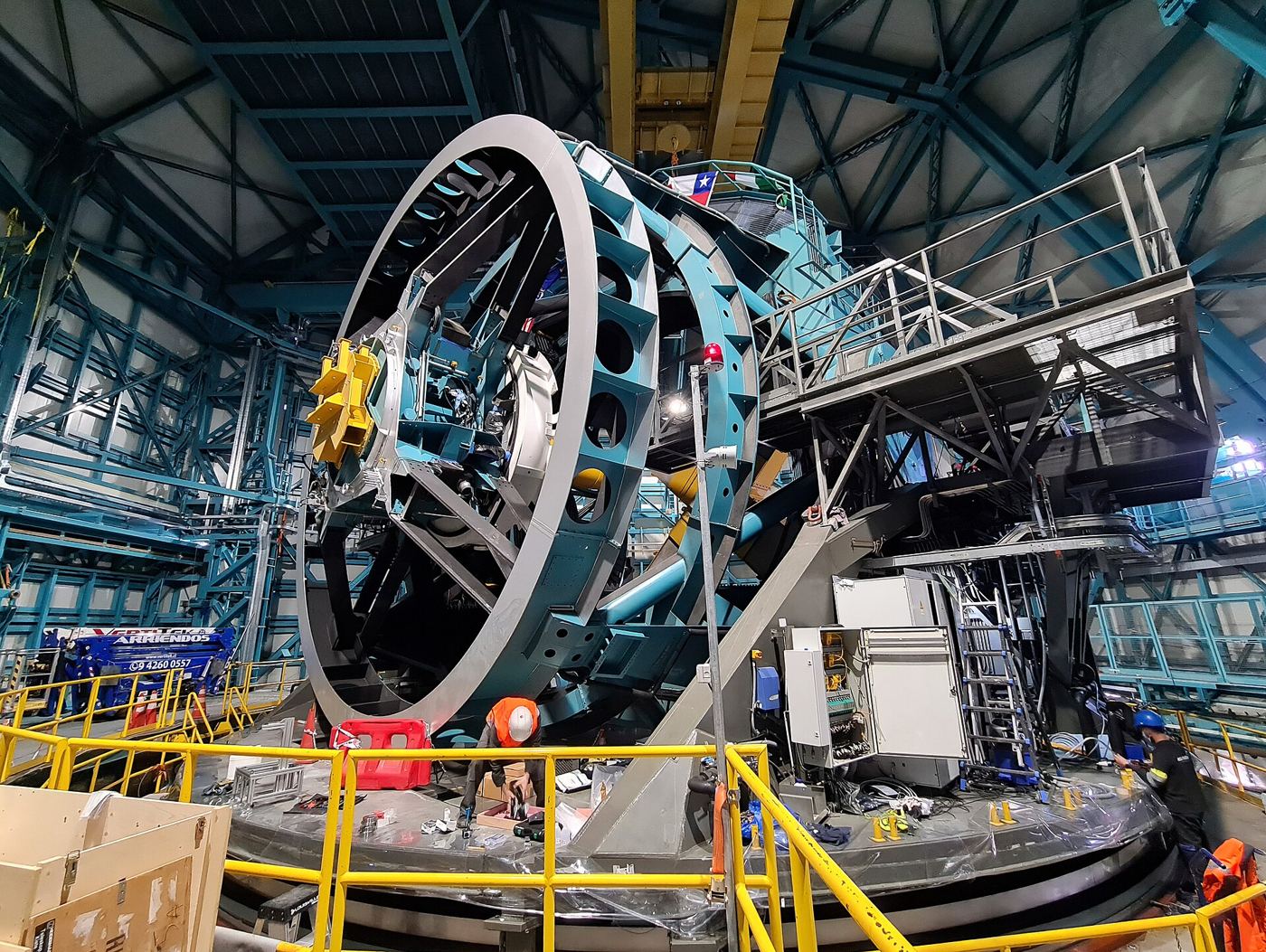
On a mountaintop in Chile, the largest digital camera ever built is filming the sky. The Vera C. Rubin Observatory released its first images on 23 June 2025, and they showed what a decade of patient watching will look like: a single view of the Trifid and Lagoon nebulae contained millions of stars and galaxies, and in just ten hours of test observations the telescope spotted 2,104 asteroids that had never been seen before. The observatory’s 8.4-metre telescope carries a 3.2-gigapixel camera, roughly the size of a small car, and it will photograph the entire southern sky every few nights for ten years. The project, called the Legacy Survey of Space and Time, began its ten-year run in June 2026, and it is expected to collect about 20 terabytes of data every night. Named after the astronomer Vera Rubin, whose work provided the first strong evidence for dark matter, the observatory is a joint project of the US National Science Foundation and the Department of Energy.
What the Evidence Shows
The point of photographing the same sky again and again is change. Most telescopes take a snapshot; Rubin makes a film. Anything that moves, brightens, fades or explodes will be caught, from asteroids drifting near Earth to supernovae flaring in distant galaxies, and alerts will go out to astronomers around the world within minutes. Over ten years the survey should catalogue billions of galaxies and tens of millions of stars, giving scientists the data to map dark matter, trace how the universe’s expansion is accelerating and work out how the Milky Way was assembled from smaller galaxies. The data will be public, so researchers far beyond the observatory’s own team can mine it for discoveries nobody has planned yet. The first images were only a taste, but they already proved the optics, the camera and the alert system all work as designed. Reporting and analysis from sources such as Nature track the same developments, and specialists following Vera Rubin Observatory sky survey say the direction is now consistent across independent lines of evidence.
The Wider Context
The wider context is a research landscape in which replication and open data now decide reputations. Findings connected to Vera Rubin Observatory sky survey are being checked by independent groups with shared datasets, and the teams involved publish their methods in full so rivals can test every step. That discipline is slower than a headline cycle, but it is why results in this area increasingly survive first contact with scrutiny.
What Happens Next
What happens next in the story of Vera Rubin Observatory sky survey will be decided by follow-up work already under way: larger samples, longer observation and instruments that have not yet come online. The researchers involved are unusually united on one point, that the current results justify the next investment of time and money. Readers will not have to wait long for the first tests of that claim. You can follow related developments in our coverage of science.
None of this will be settled by a single announcement, study or product launch. The pattern to watch is accumulation: independent confirmations, honest reporting of failures and steady improvement in the underlying numbers. Readers who follow those signals, rather than the loudest claim of the week, will understand this subject better than most of the commentary surrounding it suggests is possible.
